

Quick question: if your bank locked its doors tomorrow morning, how much of your money would you actually get back?
Most people answer “all of it” without thinking twice — and honestly, for most people, that’s the right answer. The reason is FDIC insurance, the federal backstop sitting quietly behind your checking and savings accounts. You’ve probably seen the little “Member FDIC” logo a thousand times and never given it a second thought. Fair enough. But the details matter more than you’d expect, especially once your balances climb past a certain number.
This guide walks through how it all works — with real dollar amounts, not abstractions.
Table of Contents
What FDIC Insurance Actually Is
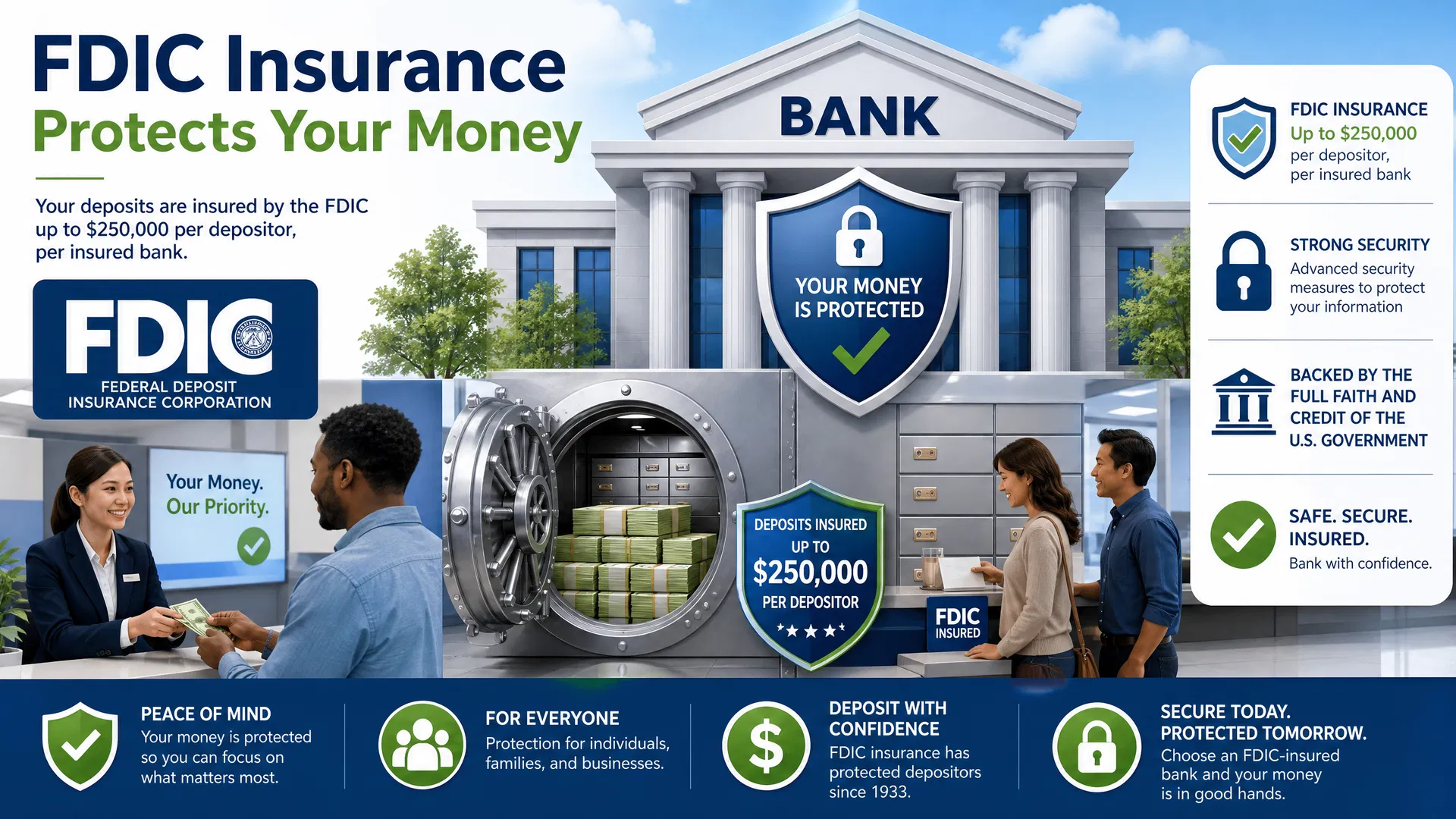
The Federal Deposit Insurance Corporation has been around since 1933, born out of the bank runs of the Great Depression. The deal is simple: if your bank is FDIC-insured and it fails, the government guarantees your deposits up to the coverage limit. You don’t sign up for anything. You don’t pay a premium. If the bank is a member, you’re covered automatically the moment your money lands in the account.
And here’s the stat that does all the talking: since 1933, not a single depositor has lost a penny of FDIC-insured deposits. Not during 2008. Not during the 2023 bank scares. Zero.
The $250,000 Rule, Explained With Real Numbers
The headline number is $250,000 per depositor, per insured bank, per ownership category. Sounds simple. It isn’t — because that “per ownership category” part is where the interesting math lives. Let me show you.
Scenario 1: One person, one account, $300,000
Say you’ve got $300,000 sitting in a savings account at a single bank, all in your name alone. Your FDIC insurance covers $250,000 of it. The remaining $50,000? Uninsured. If that bank failed, you’d get the $250,000 back fast — the extra $50,000 would depend on what the FDIC recovers from selling off the bank’s assets, which can take months and isn’t guaranteed.
The fix is almost embarrassingly easy: move $50,000 to a different FDIC-insured bank. Now the full $300,000 is covered — $250,000 at bank A, $50,000 at bank B. Same money, zero risk. (If you’re shopping around for a second home for your cash, here’s how today’s best high-yield savings accounts compare on rates and fees.)
Scenario 2: A couple with $500,000 in a joint account
Tom and Lisa share a joint savings account holding $500,000. Is half of it uninsured? No — it’s fully covered. Joint accounts get $250,000 of coverage per co-owner, so Tom’s $250,000 share and Lisa’s $250,000 share are each insured. Total coverage: $500,000. Every dollar protected.
This is the single most underused trick in personal finance. Married couples who keep everything in one spouse’s name are leaving coverage on the table for no reason.
Scenario 3: Multiplying coverage with POD beneficiaries
Here’s where it gets fun. A payable-on-death (POD) account — sometimes called a Totten trust — lets you name beneficiaries who inherit the account. Each beneficiary adds another $250,000 of coverage for the account owner.
Take a single dad with $700,000 in savings who names his three kids as equal POD beneficiaries. His coverage is $250,000 × 3 = $750,000. The entire $700,000 is insured at one bank, no splitting required. With five beneficiaries, one person can cover $1.25 million at a single bank.
Setting up POD beneficiaries usually takes five minutes at your bank or a few clicks online. It’s free. There’s genuinely no reason not to do it if your balances are large.
The cheat sheet
| Setup | Example balance | Covered? |
|---|---|---|
| Single account, $200,000 | $200,000 | Yes — fully covered |
| Single account, $300,000 | $300,000 | $250,000 covered; $50,000 at risk |
| Joint account (2 owners), $500,000 | $500,000 | Yes — $250,000 per owner |
| POD account, 3 beneficiaries, $700,000 | $700,000 | Yes — $250,000 per beneficiary |
| $250,000 each at 2 different banks | $500,000 | Yes — limits are per bank |
What Happens When a Bank Actually Fails
This isn’t theoretical. In March 2023, Silicon Valley Bank collapsed — the second-largest bank failure in US history at the time. Here’s what happened next, because it’s the best real-world demo of FDIC insurance you’ll ever get.
Regulators shut the bank down on a Friday. The FDIC stepped in as receiver over the weekend. By Monday morning, every depositor with insured balances had full access to their money — either through a bridge bank the FDIC set up or via direct payouts. No forms, no waiting rooms, no panic required.
Depositors with balances above the insurance limit got what are called receivership certificates for the excess, plus an advance dividend payment. They eventually recovered most of it, but it took time and there was real uncertainty for weeks. That’s the difference the $250,000 line makes: below it, Monday morning; above it, months of maybe.
Typical timeline for a straightforward failure: insured funds available within one to two business days. That’s it.
What FDIC Insurance Does NOT Cover
This is the part people get wrong most often. FDIC insurance covers deposits — checking accounts, savings accounts, money market deposit accounts, and CDs. That’s the list. Everything else is on its own.
Not covered:
- Stocks, bonds, ETFs, and mutual funds — even if you bought them through your bank’s investment arm. If the market drops, FDIC insurance doesn’t cover them.
- Cryptocurrency — not FDIC-insured anywhere, no matter what a crypto platform’s marketing implies. Some platforms keep customer dollars at partner banks (which may be FDIC-insured), but the crypto itself never is.
- Annuities and life insurance policies — these are insurance products, regulated at the state level, with their own separate guaranty associations.
- Safe deposit box contents — the box is rented space, not a deposit. What’s inside is your responsibility.
- Treasury bonds and savings bonds — backed by the full faith of the US government, but through the Treasury, not the FDIC. Different program, same practical safety.
The pattern: if it can lose value because markets move, FDIC insurance doesn’t cover it. FDIC insurance protects against bank failure, not investment risk.
The Brokered-CD Trap Most People Miss
Here’s a sneaky one. Say you buy certificates of deposit through a brokerage — Fidelity, Schwab, wherever. Those “brokered CDs” are issued by real FDIC-insured banks, so you’d assume you’re covered. And you are — on a pass-through basis, meaning the insurance flows through the brokerage to you.
The trap has two jaws. First, coverage aggregates by the issuing bank, not by the brokerage. If you buy a $200,000 CD from Bank X through Fidelity and another $200,000 CD from the same Bank X through Schwab, you don’t have $200,000 of coverage twice. You have $400,000 at one bank — $150,000 of it uninsured — and neither brokerage will warn you.
Second, and this one bites harder: if the brokerage firm fails (not the bank), FDIC insurance doesn’t apply at all. That’s a different problem with different protections. Brokered CDs are a fine product, but you have to track which banks issued them and keep a running total per bank. A spreadsheet takes ten minutes and can save you a very bad surprise.
How to Check Your Bank Is Actually Covered
Don’t assume — verify. It takes about sixty seconds:
- Go to fdic.gov and use the BankFind tool to confirm your bank is FDIC-insured.
- Look for the “Member FDIC” logo on your bank’s website and mobile app. Legit banks display it prominently.
- If you’re opening a brand-new account somewhere, confirm before you move money — here’s a step-by-step guide to opening a bank account online that walks through the whole process.
One more thing worth knowing: credit unions aren’t FDIC-insured — they’re covered by the NCUA (National Credit Union Administration), which works almost identically with the same $250,000 limit. Different logo, same protection.
FDIC Insurance FAQ
Is FDIC insurance automatic, or do I need to sign up?
Completely automatic. If your bank is FDIC-insured, every eligible deposit is covered from the moment it hits your account. No enrollment, no fees, no paperwork.
I have $400,000 at one bank in my name only. Am I covered?
Only $250,000 of it. Your options: move $150,000 to a second FDIC-insured bank, add a joint owner, or name POD beneficiaries to multiply your coverage at the same bank. All three work; pick whichever fits your situation.
Are online banks FDIC-insured?
Most of them, yes — the big online banks are FDIC members just like brick-and-mortar ones. But “most” isn’t “all,” especially with newer fintech apps. Some fintechs aren’t banks at all; they park your money at partner banks. Verify on fdic.gov before depositing anything significant.
Do credit unions have FDIC insurance?
No — credit unions are insured by the NCUA instead, which provides essentially the same protection: $250,000 per member, per credit union. If your credit union displays the NCUA logo, your deposits are safe.
How fast do I get my money if my bank fails?
Usually within one to two business days. The standard FDIC insurance playbook is to have insured deposits available the next business day after closure, either through an acquiring bank or direct payment. It’s designed to be boring — and it works.
Disclaimer: This article is for general educational purposes only and is not financial advice. FDIC rules and coverage limits can change over time — always verify your bank’s insured status and current limits before making decisions about large deposits.