
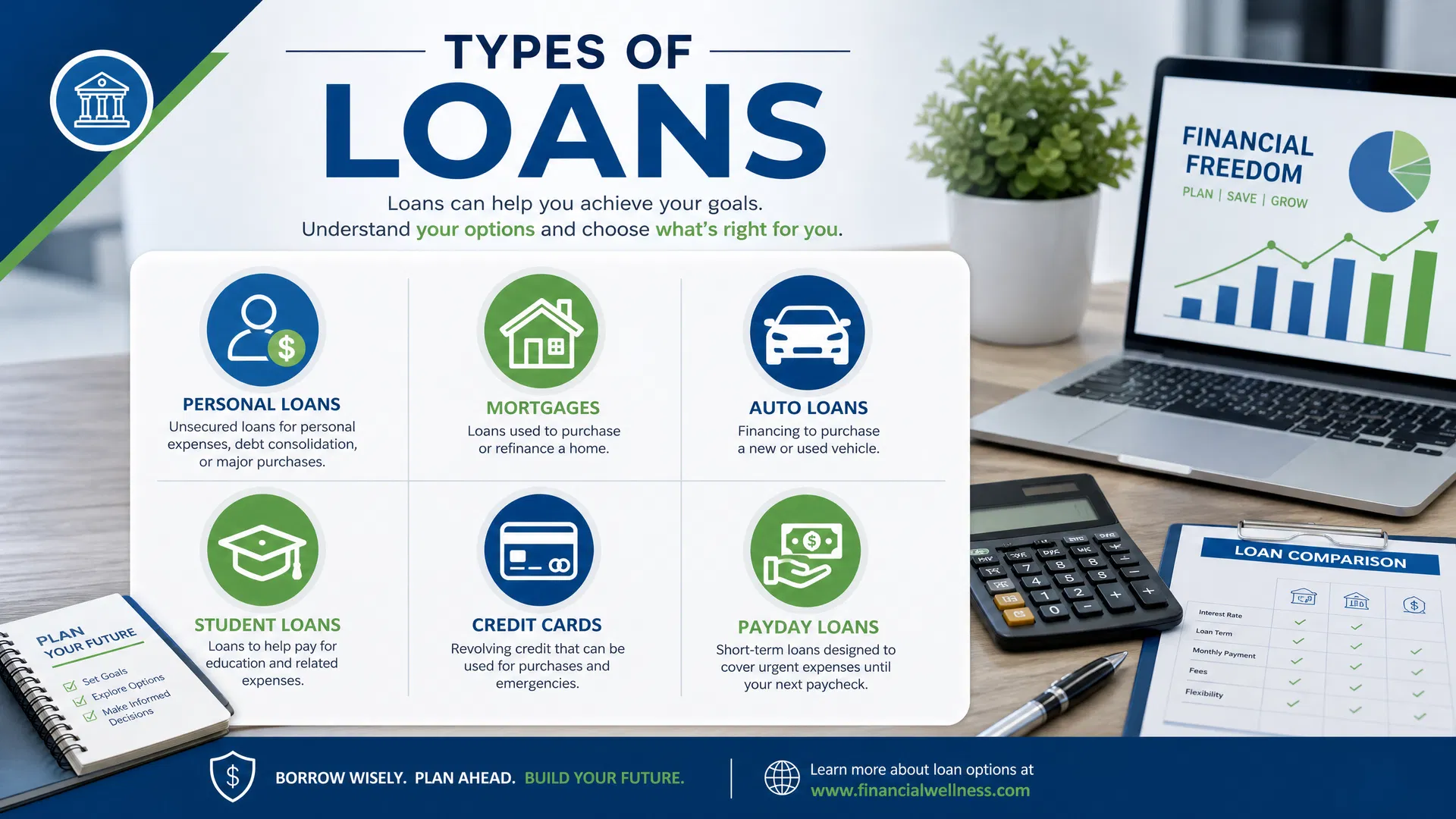
When my friend Daniel called me last spring, he wasn’t asking which bank to pick. He was drowning in browser tabs — fifteen of them, each one a different loan, each one promising to be the answer. Mortgage, personal loan, HELOC… He finally just said, “I don’t even know what half of these words mean.” And honestly? Most people don’t. The types of loans out there seem to multiply every year, and lenders are perfectly happy to keep you confused, because confused borrowers sign bad deals. So let’s fix that. Here’s every major loan type explained in plain English — what it actually costs, when it genuinely makes sense, and the traps I’d tell my own family to avoid.

Before Anything Else: How Types of Loans Actually Work
Strip away the jargon and every loan is the same deal: someone hands you a lump sum (the principal), and you pay it back over time (the term) with extra tacked on (the interest). The interest rate that matters is the APR — annual percentage rate — because it folds in most fees, not just the headline rate. Two loans can advertise the same “rate” and cost you wildly different amounts once fees are included. Always compare APR to APR.
There’s one more split that shapes everything: secured vs. unsecured. A secured loan is backed by something the lender can take — your house, your car. Because the lender’s risk is lower, secured loans are cheaper. An unsecured loan is backed by nothing but your promise and your credit history, so it costs more. Every loan below falls on one side of that line, and that line explains most of the price differences you’ll see.
One honest note on rates before we start: I’ll give realistic ranges, but rates move constantly with the economy. Treat every number here as a ballpark, not a quote — always check what lenders are actually offering the week you apply.
Mortgages: The Big One
Let’s start where the most money is. My neighbors, Sarah and Tom, bought their first house last year: $400,000 purchase price, 20% down ($80,000 — years of saving), leaving a $320,000 mortgage. On a 30-year fixed rate around 7%, their monthly payment landed near $2,130 before taxes and insurance. Over 30 years, they’ll pay roughly $447,000 in interest alone. Read that again. The interest costs more than the house. That’s the scale of a mortgage — and why even a half-point difference in rate matters enormously.
The 30-year fixed-rate mortgage is the default choice in America for a reason: your payment never changes, which makes budgeting possible across decades. The 15-year fixed charges a lower rate and builds equity dramatically faster, but the monthly payment jumps — on that same $320,000 loan, you’d pay around $2,850 a month instead of $2,130. Most first-time buyers can’t swing that, and that’s fine.
If you can’t put 20% down, you’re not locked out. FHA loans let you buy with as little as 3.5% down (you’ll pay mortgage insurance, which adds to the monthly bill). VA loans — for eligible veterans and service members — require zero down and no mortgage insurance, and they’re genuinely one of the best deals in all of lending. Conventional loans from lenders like Rocket Mortgage, Chase, or your local credit union typically want 5–20% down depending on your credit.
My honest opinion: buy less house than the bank says you can afford. Lenders will happily approve you for a payment that leaves you house-poor. And be deeply skeptical of adjustable-rate mortgages (ARMs) unless you truly understand them and have a concrete plan to sell or refinance before the rate adjusts. An ARM that starts at 5.5% and resets to 8% in five years has wrecked more household budgets than almost any other financial product.
Personal Loans: The Swiss Army Knife
A personal loan is simple: the bank deposits a lump sum in your account, you repay it in fixed monthly installments over two to seven years, and there’s no collateral. Because it’s unsecured, rates run higher than mortgages or auto loans — typically somewhere in the 8–12% range for borrowers with good credit, climbing to 20–36% if your credit is rough.
Here’s where personal loans genuinely shine: debt consolidation. Picture this — you owe $18,000 across three credit cards at an average of 24% interest, paying minimums and getting nowhere. You take a 5-year personal loan at 11% from an online lender like SoFi, LightStream, or Marcus. Same debt, but now it’s one fixed payment, a finish line, and you’d save roughly $8,000–$10,000 in interest compared to dragging those card balances along. I’ve seen this move single-handedly turn someone’s finances around.
They’re also reasonable for one-time expenses you can’t avoid — a medical bill, a necessary car repair, a security deposit plus first month’s rent when you’re relocating for work. What they’re terrible for: vacations, weddings you can’t afford, or “investing” in crypto. Borrowing at 12% to fund something that depreciates the moment you buy it is how people dig holes.
One distinction worth making: a personal loan gives you a lump sum you pay down. If what you actually need is flexible, ongoing access to credit, that’s a different tool — here’s how unsecured credit cards work, and when a card beats a loan.
Auto Loans: Where the Dealership Makes Its Real Money
Here’s something most car buyers don’t realize: the dealership’s finance office is often more profitable than the car sale itself. That “great rate” they offer you? They may have marked it up a point or two above what the bank actually approved, pocketing the difference. This is why the single smartest move in car buying has nothing to do with the car — it’s getting preapproved for a loan from your bank or credit union before you walk onto the lot.
The math on a typical deal: a $28,000 car, $4,000 down, financing $24,000 at 7% over 60 months. That’s about $475 a month, and you’ll pay roughly $4,500 in interest over the life of the loan. Stretch it to 72 months and the payment drops to about $408 — tempting — but you’ll pay around $5,400 in interest and spend an extra year owing money on a depreciating asset. The 84-month loans some dealers push now? You’re paying for a car long after the new-car smell is a distant memory, and you’ll owe more than it’s worth for years.
Realistic rate ranges: new-car loans run roughly 5–8% for good credit, 9–14%+ if your credit is shaky. Used-car loans cost a bit more across the board. Credit unions consistently beat dealership and big-bank rates — if you’re not checking with one, you’re probably overpaying.
My honest opinion: the cheapest car is almost always the one you can nearly pay cash for, but if you must finance, keep the term at 60 months or less and put at least 10–20% down. And never — never — negotiate based on monthly payment alone. That’s the dealer’s favorite game: they can hit any monthly number you name by stretching the term and quietly inflating the total cost.
Student Loans: The One With No Bankruptcy Escape Hatch
Student loans deserve a frank conversation because they behave differently from every other debt: in most cases, you cannot discharge them in bankruptcy. That fact alone should change how much you borrow.
Federal student loans should always be your first stop. The interest rate is fixed by Congress each year — recent undergraduate rates have landed around 6.5% — and they come with protections private loans don’t: income-driven repayment plans, deferment, and potential forgiveness programs for public-service work. You don’t even need a credit history to get them.
Private student loans, from lenders like Sallie Mae or College Ave, are a different animal: rates typically range from around 4% to 14% depending on your (or your cosigner’s) credit, terms are set by the lender, and those federal safety nets don’t exist. They’re worth considering only after you’ve maxed out federal options — and be very careful about refinancing federal loans into a private one later, because the moment you do, you permanently give up the federal protections.
Let me be blunt: borrow as little as humanly possible. Every $10,000 you borrow at 6.5% on a 10-year plan costs you about $114 a month and roughly $3,600 in interest. That doesn’t sound catastrophic until you realize the average borrower leaves school with over $30,000 in debt — and monthly payments don’t care that your entry-level salary is modest. The degree matters enormously too: $40,000 in debt for an engineering degree and $40,000 for a degree with weak job prospects are completely different financial decisions wearing the same costume.

Business Loans: Fuel, Not a Life Raft
When my cousin wanted to expand his small landscaping business — second truck, two more crew members — he needed about $60,000 he didn’t have. This is what business loans are for: borrowing to buy something that earns more than the loan costs.
The gold standard is the SBA 7(a) loan: backed by the Small Business Administration, borrow up to $5 million, with rates typically around prime plus 2–3% (think roughly 9–11% in recent years) and terms up to 10 years for working capital, 25 for real estate. The catch is paperwork and patience — approval can take 30 to 90 days, and you’ll need solid financials. Banks like Chase, Wells Fargo, and Live Oak (an SBA specialist) are big players here.
Need money faster? Online lenders like OnDeck or Fundbox can fund you in days, sometimes 24 hours. But speed has a price — effective rates can run 20–50%+ on short-term products. That’s not always a ripoff; if a $20,000 advance at a steep cost lets you fulfill a $60,000 contract this month, the math can work. But borrowing expensive money to cover operating losses is just a slower way to go broke.
My honest opinion: a business loan should fund growth with a clear return, never plug a leaking bucket. If the business can’t show how the borrowed money comes back with profit, the answer isn’t a loan — it’s fixing the business first. And keep business debt legally separate from personal finances wherever possible; commingling the two is how one failing venture takes down a household.
Home Equity Loans vs. HELOCs: Borrowing From Your House
If you’ve owned your home for a while and it’s gone up in value, you’ve built equity — the gap between what the home is worth and what you owe. Lenders will let you borrow against it, usually up to 80–85% of the home’s value minus your remaining mortgage. The math: a $500,000 home with $300,000 left on the mortgage gives you roughly $100,000 in borrowable equity (80% of $500,000 is $400,000, minus the $300,000 you owe).
You get this money in two flavors. A home equity loan hands you a lump sum with a fixed rate (recently around 8–9%) and fixed payments — basically a second mortgage. A HELOC (home equity line of credit) works like a credit card secured by your house: you draw what you need during a draw period (usually 10 years), with a variable rate (recently around 8–10%), then repay over the next 10–20 years.
When does this make sense? A kitchen renovation that genuinely raises the home’s value. Consolidating high-interest debt if you’ve fixed the spending problem that created it. When is it reckless? Funding a lifestyle — vacations, cars, boats — with your house as collateral. A HELOC’s variable rate can also bite: that comfortable payment at 8% gets a lot less comfortable at 11%.
My honest opinion, stated plainly: this is the loan type where the stakes are highest, because the collateral is where you live. A fixed home equity loan for a value-adding project is reasonable. A HELOC used as an emergency credit card is how people who “had it all” end up in foreclosure. Respect what you’re putting on the table.
Types of Loans Compared: Every Major Option, Side by Side
| Loan type | Typical APR range | Secured? | Typical term | Best for |
|---|---|---|---|---|
| Mortgage | ~6.5-8% | Yes (the home) | 15-30 years | Buying a home you can truly afford |
| Personal loan | ~8-36% | No | 2-7 years | Debt consolidation, one-time expenses |
| Auto loan | ~5-14% | Yes (the car) | 3-7 years | Buying a car with 10-20% down |
| Student loan (federal) | ~6-7% fixed | No | 10-25 years | Education, after exhausting grants/scholarships |
| Student loan (private) | ~4-14% | No | 5-15 years | Gap funding after federal loans |
| Business loan (SBA) | ~9-11% | Sometimes | Up to 10-25 years | Funding clear, profitable growth |
| Home equity loan | ~8-9% | Yes (the home) | 5-30 years | Value-adding renovations, careful consolidation |
| HELOC | ~8-10% variable | Yes (the home) | 10-year draw + repayment | Flexible access for planned projects |
Ranges are approximate and move with the market — always compare live offers.
The Loans You Should Run From: Payday and Title Loans
I need to be direct here, because these products target people at their most desperate. A payday loan gives you a few hundred dollars until your next paycheck — and charges the equivalent of 300–600% APR. A $500 payday loan can easily cost $75 in fees every two weeks; roll it over a few times (which is what the business model counts on) and you’ve paid more in fees than you borrowed. Title loans are the same trap with your car as collateral: borrow $1,000 against your paid-off car, miss payments, and you lose the vehicle you need to get to work.
These aren’t loans in any meaningful sense — they’re debt traps engineered to be rolled over. The Consumer Financial Protection Bureau has documented how the typical payday borrower stays indebted for months, paying fee after fee. If you’re considering one, stop and look at literally any alternative first: a payment plan with the creditor, a local credit union’s small-dollar loan, a paycheck advance from your employer, even a credit card cash advance (expensive, but not 400% APR expensive). Anything but this.
How to Actually Choose: A 5-Minute Framework
Forget memorizing loan types. When you need to borrow, run through this instead. First: is this for something that holds or grows value — a home, an education, business equipment — or something that evaporates? Borrow eagerly for the first category, reluctantly for the second. Second: match the loan to the purpose. Don’t finance a car with a personal loan at 14% when an auto loan costs 7%. Don’t put tuition on a credit card when federal student loans exist. The right loan for the job is almost always cheaper than the convenient one. Third: compare APR, not monthly payment. Anyone can make a payment look small by stretching the term — the APR tells you what you’re really paying. Fourth: check your credit first. A score 40 points higher can mean thousands less in interest, and building it before you borrow is one of the highest-return moves in personal finance — here’s how to build credit from scratch if you’re starting at zero. Fifth: read the prepayment terms. Most good loans let you pay extra or pay off early with no penalty. If a loan punishes you for paying it back faster, walk away.
Frequently Asked Questions
Which type of loan has the lowest interest rate?
Mortgages, almost always — typically 6.5–8% in recent years — because they’re secured by the house and spread over decades. Secured loans beat unsecured loans on rate nearly every time, which is exactly why borrowing against your home is cheap and borrowing on a credit card is brutally expensive.
Can I get a loan with bad credit?
Yes, but you’ll pay for it. Secured options (auto loans, secured cards) are the most forgiving because the lender holds collateral. For unsecured personal loans with poor credit, expect rates of 20–36% — at which point it’s worth asking whether borrowing is the right move at all, versus spending a few months improving your credit first.
What’s the difference between APR and interest rate?
The interest rate is just the cost of borrowing the principal. The APR includes the interest rate plus most lender fees, expressed as a yearly rate. Two loans with the same interest rate can have different APRs — the APR is the number to compare.
Is it better to get preapproved before shopping for a car or house?
Yes, always. Preapproval tells you what you can actually afford, locks in a rate to beat, and — especially with cars — takes away the dealer’s biggest profit lever. Never let the seller arrange your financing without competing offers in hand.
Should I pay off debt or invest the money instead?
Compare the numbers honestly. Paying off a 22% credit card is a guaranteed 22% return — no investment beats that reliably. Paying down a 7% mortgage early versus investing is a closer call and mostly comes down to your risk tolerance and timeline. Kill high-interest debt first, always.
Disclaimer: This article is for general educational purposes only and is not financial advice. Loan rates, terms, and programs change over time and vary by lender and borrower — always compare current offers and consider speaking with a qualified financial professional before borrowing.

2 comments