

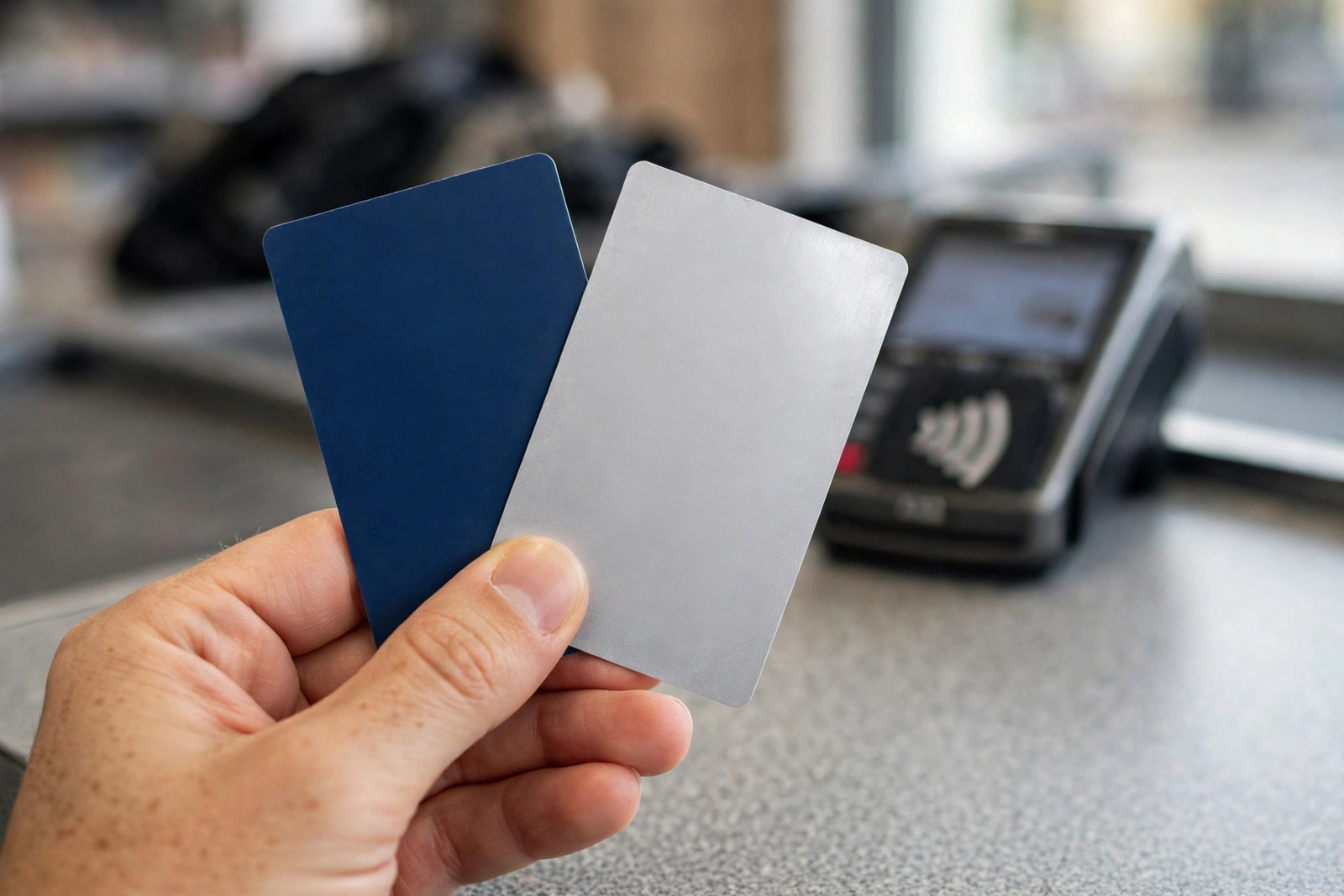
Last month my cousin waved two cards at me across the dinner table — a debit card from his bank and a prepaid Visa he’d bought at a drugstore — and asked which one was “the better deal.” I get this question more often than you’d think, because honestly, at the checkout register the debit card vs prepaid card debate looks like no debate at all. Both are plastic. Both say Visa or Mastercard. Both let you tap and pay. But under the hood they work completely differently, they charge you completely differently, and picking the wrong one can quietly cost you real money. Here’s how each card actually moves your money, where the fees hide, and which one belongs in your wallet. Read on for the full debit card vs prepaid card comparison.
The 30-Second Version
A debit card is a key to your checking account — every swipe pulls money straight out of funds you already deposited. A prepaid card is a stored-value card you load with money in advance — every swipe pulls from that loaded balance and nothing else. No bank account is attached to a prepaid card at all.
Neither one lets you borrow money, and neither one builds your credit. If you’re comparing them, what really matters is three things: the fees, the consumer protections, and whether you even have (or want) a bank account. Let’s take each in turn. That single difference drives most of the debit card vs prepaid card trade-offs covered below.
How a Debit Card Actually Moves Your Money
When you open a checking account, the bank hands you a debit card linked directly to it. Buy groceries for $64.20, and $64.20 leaves your account — usually within a day, often within minutes. Your spending limit is whatever’s in the account, plus whatever daily limit your bank sets for card transactions.
Debit cards come with the full banking package: a mobile app to track spending, direct deposit for your paycheck, free withdrawals at your bank’s ATMs, and often no monthly fee as long as you meet basic conditions (a free checking account with no minimum balance, for example, pairs perfectly with a debit card).
The downside shows up when your balance runs dry — if you don’t have overdraft protection turned off, the bank may let the payment through and charge you an overdraft fee, which at many big banks still runs around $30-plus per transaction. The Consumer Financial Protection Bureau has been pushing banks to rein these in, and plenty of online banks have dropped overdraft fees entirely, but it remains the single biggest “gotcha” in debit card land.
How a Prepaid Card Actually Moves Your Money
A prepaid card starts empty. You buy it at a store, online, or sometimes through an employer or government benefits program, then load money onto it — with cash at a register, through direct deposit, or by transferring from a bank account. Once the loaded balance is gone, the card declines until you reload. It cannot go negative, which means it cannot overdraft. That’s the entire appeal for people who want hard spending limits.
The catch is that prepaid cards are fee machines compared to debit cards. Typical charges include an activation fee when you buy the card, a monthly maintenance fee just for keeping it, a fee every time you reload cash, ATM withdrawal fees, and sometimes even an inactivity fee if the card sits unused for a couple of months. Individual amounts vary by issuer, but it’s common to see monthly fees of several dollars plus a few dollars per cash reload — costs that quietly eat a low balance alive.
Why would anyone accept that? Because you don’t need a bank account, a credit check, or an ID verification process as strict as a bank’s to get one. Roughly 6% of US adults are unbanked, and for them a prepaid card is often the most practical way to shop online, pay bills, or receive wages without paper checks. Parents also use them as allowance tools for teenagers, and travelers sometimes use them as a fixed-budget spending card.
Debit Card vs Prepaid Card: Side-by-Side
| Feature | Debit Card | Prepaid Card |
|---|---|---|
| Linked to a bank account | Yes — pulls from your checking balance | No — stands alone with a loaded balance |
| Bank account required | Yes | No |
| Credit check to get one | Usually no | No |
| How you add money | Direct deposit or transfer into your account | Cash reload, direct deposit, or transfer onto the card |
| Activation fee | None | Usually yes ($2–$10) |
| Monthly fee | Often $0 (especially at online banks) | Common (several dollars/month) |
| Cash reload fee | N/A | Usually yes |
| Overdraft possible | Yes — unless you opt out | No — card simply declines |
| Builds credit | No | No |
| Fraud protection | Strong — federal debit card protections | Decent since 2019 — CFPB prepaid rule requires investigation and reimbursement if you report quickly |
The Real Cost Comparison
Let me make the fee difference concrete. Take a no-fee online checking account: you pay $0 monthly, $0 to receive direct deposit, $0 for in-network ATM withdrawals. Your cost of carrying that debit card for a year is essentially zero.
Now take a typical prepaid card: a one-time activation charge, a monthly fee, a fee each time you load cash at a register, and an ATM fee when you withdraw. If you reload twice a month and use the card for a year, you can easily spend $100 or more just on fees — on money that was already yours. That’s not a scam; it’s the business model. Prepaid issuers make their money from fees, not from lending or deposits.
My take: if you can open a checking account, a debit card wins on cost almost every time. The fee gap is so wide that a prepaid card only makes sense when a bank account genuinely isn’t available to you. That’s the bottom line of this debit card vs prepaid card cost comparison.

Fraud Protection: Your Rights on Each Card
This is where debit cards have historically had the edge in the debit card vs prepaid card comparison, though the gap has narrowed. Debit cards fall under the Electronic Fund Transfer Act: if you report a lost or stolen card within two business days, your liability for unauthorized charges is capped at $50; wait longer and it can rise to $500, and beyond 60 days you can be on the hook for everything. The practical advice is simple — check your account regularly and report problems immediately.
Prepaid cards got a major upgrade in April 2019, when the CFPB’s prepaid rule took full effect. Issuers must now investigate errors you report and generally reimburse unauthorized charges if you report the loss promptly — similar in spirit to debit card protections.
Credit cards still have the strongest protections of the three (thanks to the Fair Credit Billing Act), which is one reason many people put big online purchases on credit. But the old line that “prepaid cards have no fraud protection” is outdated — just read your specific card’s terms, because details vary by issuer. The Consumer Financial Protection Bureau publishes plain-English guidance on prepaid cards.
Neither Card Builds Credit — Here’s What Does
This is the misconception I hear most: people assume that using a debit or prepaid card responsibly “builds credit history.” It doesn’t. Neither card involves borrowing, so neither reports to the credit bureaus. Swiping your debit card perfectly for ten years gives you exactly zero credit score.
If building credit is your goal, you need an actual credit product. Two beginner-friendly options: a secured credit card (you put down a refundable deposit, which becomes your credit limit, and your on-time payments get reported) or a credit-builder loan (the “loan” amount sits in a savings account while you make payments that get reported). Our comparison of credit-builder loans vs secured cards breaks down which one builds credit faster for different situations.
So Which Should You Pick?
The debit card vs prepaid card question doesn’t have a universal answer — it has a your-situation answer:
- Pick a debit card if you have or can open a checking account — especially a free checking account with no minimum balance. It’s cheaper, comes with better banking tools, and the fraud protections are battle-tested.
- Pick a prepaid card if you can’t open a bank account right now (for example, after a ChexSystems denial), want a strict spending cap for a teen or a trip budget, or need something immediately without bank approval. Just go in with your eyes open about the fees and compare issuers — they differ a lot.
- Pick neither for credit building. Get a secured card or a credit-builder product instead.
For my cousin at the dinner table, the answer was the debit card — he had a checking account already and was paying a monthly fee on a prepaid card for no reason. That settled our family debit card vs prepaid card debate on the spot. For someone without a bank account, the prepaid card is a perfectly reasonable bridge. The cards aren’t really competitors; they’re answers to different problems, and now you can settle the debit card vs prepaid card question for your own wallet with confidence.
The bottom line on the debit card vs prepaid card decision: if you can open a checking account, the debit card wins on fees and fraud protection. If a bank account isn’t an option right now, a prepaid card still beats carrying cash — and whichever side of the debit card vs prepaid card choice you land on, remember that neither card builds credit.
Frequently Asked Questions
Can I get a prepaid card without a Social Security number or bank account?
In most cases, yes — that’s the main selling point. General-purpose reloadable prepaid cards typically don’t require a bank account or a credit check, and identification requirements are lighter than a bank’s (though federal rules still require issuers to verify your identity for reloadable cards).
Do prepaid cards work everywhere debit cards do?
Almost. Because they run on Visa, Mastercard, or American Express networks, they’re accepted anywhere those networks are. The exceptions are places that require a credit card specifically (some car rental agencies and hotels), and some prepaid cards restrict international use — check the terms.
Can a prepaid card be overdrawn?
No, and that’s a genuine advantage. A prepaid card can only spend the loaded balance, so it declines rather than charging you an overdraft fee. If you find yourself paying overdraft fees on a debit card, switching your everyday spending to a prepaid card is one way to force the habit — though turning off overdraft protection on your checking account is usually the cheaper fix.
What’s the cheapest way to use a prepaid card?
Choose direct deposit for loading (usually free) instead of cash reloads (usually not), avoid ATMs outside the card’s network, use the card regularly to dodge inactivity fees, and compare the monthly fee across issuers before you buy. Better yet, use it as a bridge while you open a free checking account.
Disclaimer: This article is general educational information, not financial advice. Fees, protections, and card terms vary by issuer and change over time — always read the cardholder agreement for the specific card you’re considering. Rules also differ by state, so confirm the details that apply to you.